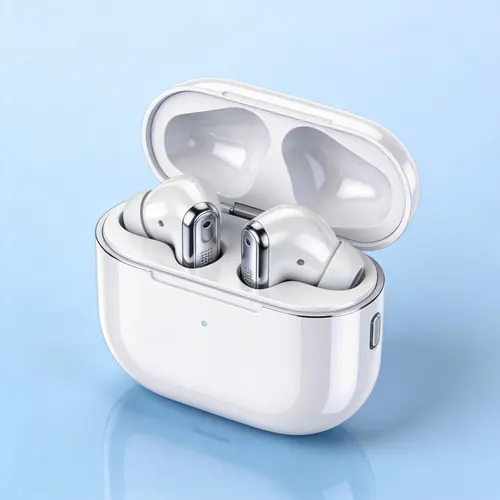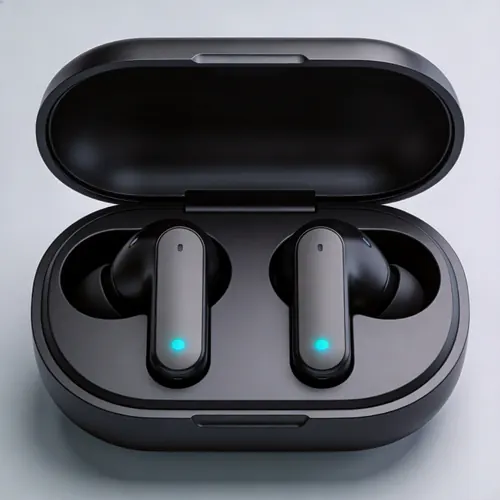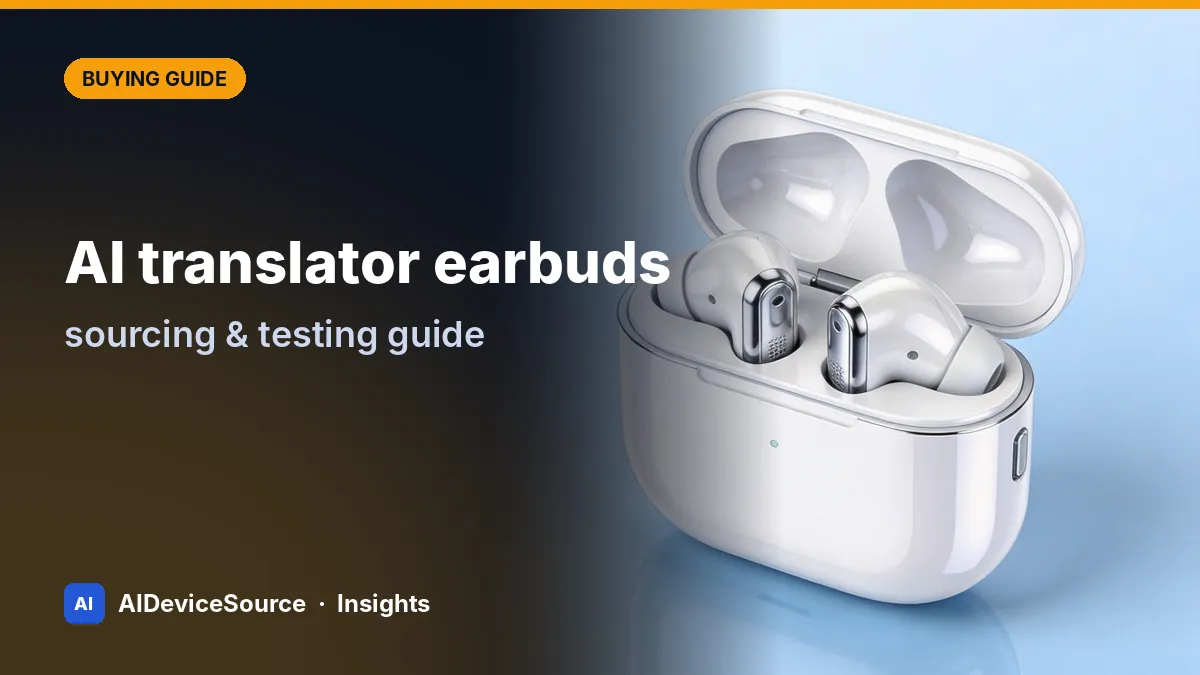
AI translator earbuds promise something everyone understands instantly: speak your language, hear theirs. That makes them one of the easiest AI gadgets to sell — to travellers, business buyers, language learners and anyone with family abroad. It also makes them easy to get wrong. A buyer will forgive average bass; they will not forgive a translation that falls apart at a hotel reception desk.
This guide explains how translator earbuds really work, which specifications deserve your attention, how to test samples properly and what to agree with your supplier before you put your brand on the box.
How AI translator earbuds actually work
Almost every model on the market follows the same chain:
- Capture — the earbud microphones (and sometimes the phone) pick up speech.
- Speech recognition — the audio is converted to text, usually by a cloud speech engine, or on the phone for offline packs.
- Machine translation — the text is translated, increasingly by large language models that handle context and idioms better.
- Speech synthesis — the translation is spoken in the other person's earbud or through the phone speaker, and shown as text in the app.
Two consequences follow. First, most of the intelligence lives in the app and the cloud, not in the earbud — so two earbuds with identical hardware can perform very differently. Second, online translation needs a data connection; without one, only the languages in the offline packs work.
Translation modes — and which buyers need which
| Mode | How it works | Best for |
|---|---|---|
| Touch-to-talk | Each speaker taps the earbud before speaking | Noisy places, travellers, first-time users |
| Simultaneous / free-talk | Both people wear an earbud and talk naturally | Business meetings, longer conversations |
| Speaker mode | You wear the earbud; the phone speaks to the other person | Shops, taxis, hotels — the other person needs no earbud |
| Listening / lecture mode | Continuous one-way translation of a speaker | Tours, conferences, classes |
| Offline mode | Phone-based recognition and translation for selected languages | Flights, roaming without data, poor coverage |
A strong model offers at least touch-to-talk, speaker mode and offline mode. Simultaneous mode is the headline feature in marketing but the hardest to do well — test it carefully before you advertise it.
The specifications that matter (and the ones that don't)
| Specification | What to look for | Why it matters |
|---|---|---|
| Online languages | 40+ languages and accents | Coverage claims vary — check your customers' specific language pairs |
| Offline packs | Number and list of offline languages (e.g. up to 8) | Decides whether the product works on a plane or abroad without data |
| Latency | From around 0.5 s on short phrases; test full sentences | Long pauses make conversations feel broken |
| Microphones | Dual-mic ENC / beamforming per earbud | The single biggest factor in noisy places |
| Battery | ~5 h per earbud, ~24 h with case | Translation sessions use more power than music |
| Bluetooth | 5.3 or newer, stable connection | Drop-outs interrupt conversations |
| App features | Transcript history, export, phrasebook, multiple modes | Business users rely on transcripts |
| Comfort & weight | ~4 g per earbud, several eartip sizes | Two people wearing earbuds need a secure, hygienic fit |
Treat headline claims like '144 languages' or '98% accuracy' with caution. Language counts often include regional variants and accents; accuracy figures are usually measured on clean, short sentences. What your customers experience depends on their language pair, accent, background noise and connection.
Earbuds vs. handheld translators
Before choosing an earbud model, decide whether your customers would be better served by a handheld translator — or both:
- Earbuds are discreet and double as everyday headphones; great for travellers and business users who want hands-free conversation.
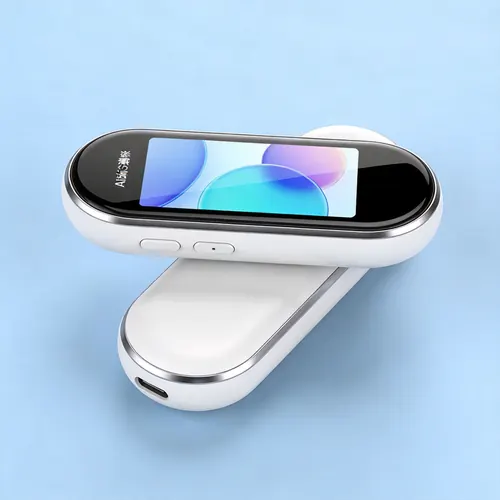
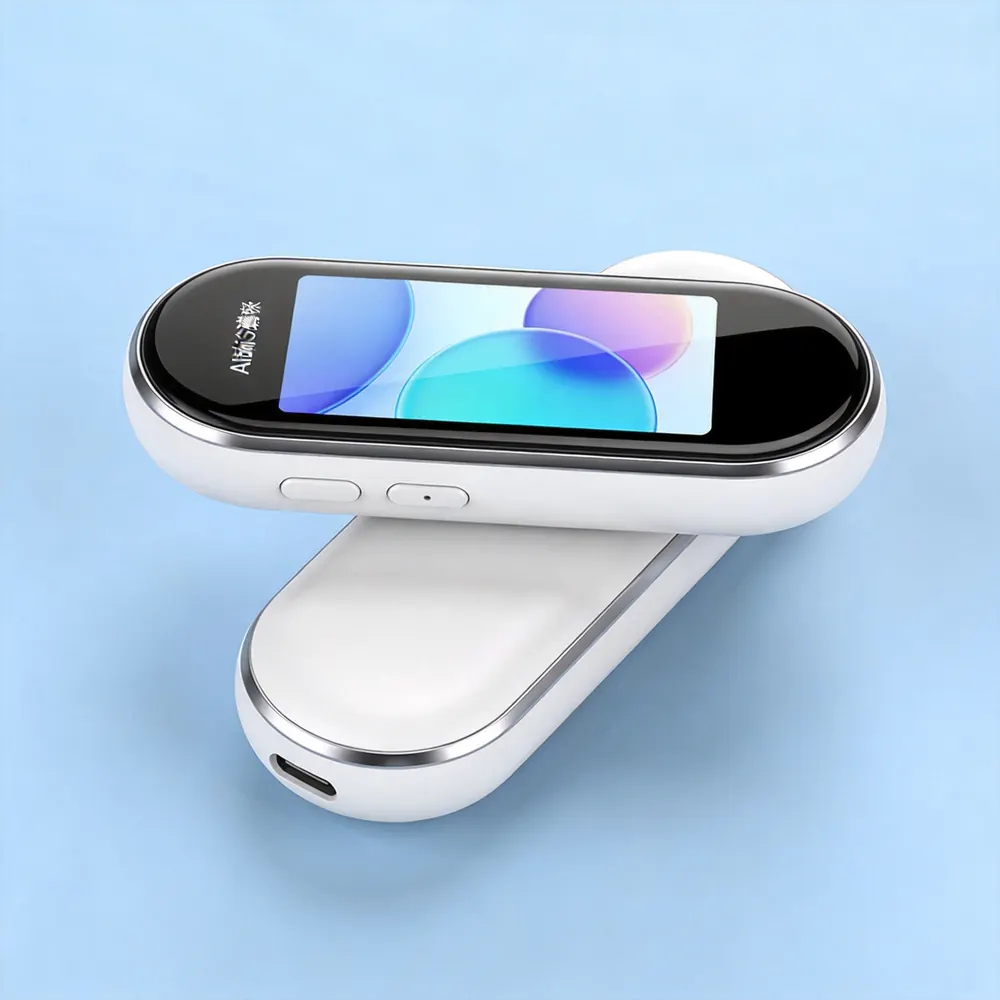
- Handheld translators add a screen, photo translation of menus and signs, and often a built-in eSIM so they don't depend on the user's phone. Popular with older travellers and frontline staff in hotels, hospitals and shops.
Browse both in our AI translator devices range.
The AI and app layer: questions to settle with the supplier
- Which speech and translation engines are used, and can the supplier switch providers if quality or pricing changes?
- Is there any per-use or subscription cost — for you or for the end user — after a free period? Are offline packs free?
- Can the app be white-labelled under your brand and developer account, or is it a shared app with your logo?
- How long will the app be maintained for new iOS and Android versions? An app that stops working on new phones turns your stock into returns.
- Where is voice data processed and stored, and is it retained? Business and EU customers will ask.
- What languages is the app interface itself translated into? A German customer expects a German app.
How to test samples: a 60-minute script
Order two or three candidate models and run the same test on each. Use real people with different accents if you can.
| Test | How | What good looks like |
|---|---|---|
| Quiet conversation | Two people, 10 everyday exchanges in your top language pair | Meaning preserved in almost all exchanges; natural voice |
| Noisy room | Repeat with café-level background noise or music | Mic still isolates the speaker; few repeats needed |
| Accents | Speakers with regional accents or non-native English | Recognition degrades gracefully, not completely |
| Latency | Time 10 full sentences from end of speech to start of translation | Consistently short pauses; no long stalls |
| Offline | Switch the phone to airplane mode; test offline pairs | Offline pairs work as advertised; clear message for others |
| Speaker mode | Talk to someone not wearing an earbud | Phone output loud and clear enough in a shop or street |
| Battery | One hour of continuous translation | Battery drop consistent with the claim |
| App | Set-up from scratch, pairing, transcript export | Under 5 minutes, no account problems |
Compliance checklist for translator earbuds
- Radio and safety: CE (RED, including the EU cybersecurity requirements for connected devices), FCC ID for the US, UKCA where required.
- Bluetooth: a valid Bluetooth SIG (BQB) listing if you use the Bluetooth name or logo.
- Restricted substances: RoHS and REACH documentation.
- Batteries: UN38.3 test summary and MSDS for shipping; note the EU battery labelling rules from 18 August 2026.
- EU charging: earbuds sold in the EU must use USB-C charging.
- AI disclosure: in the EU, from 2 August 2026 users must be informed they are interacting with an AI system where that isn't obvious — a simple line in the app and manual covers it.
Our certification guide explains each requirement in detail.
Pricing, MOQ and private label
Translator earbuds typically sit in a sample price range of roughly $38–$89 per piece depending on chipset, microphones, app features and offline languages, with tiered pricing as quantities rise. Private-label options include:
- Logo on earbuds and case, custom colours and retail packaging.
- White-label app with your brand name, icon and app-store listing.
- Custom default language list and phrasebook for your target market.
- Bundles: travel pouch, adapters, extra eartips.
A typical ODM minimum is around 300 pcs per model, with bulk production in roughly 25–35 days after artwork approval. Samples ship from 1 pc in 2–5 working days for in-stock models.
Test translator earbuds with your own language pairs
Order samples from 1 pc, or tell us your target market and languages — we'll recommend the model and app set-up that fits.
Frequently asked questions
How accurate are AI translator earbuds?
For common language pairs in quiet conditions, current models handle everyday conversation well. Accuracy drops with background noise, strong accents, slang and less common languages. Always test your customers' main language pairs in realistic conditions before ordering.
Do translator earbuds work without internet?
Only for the languages included in the offline packs, which is usually a limited set. All other languages need a data connection through the paired phone.
Do both people need to wear an earbud?
No. Most models offer a speaker mode in which you wear the earbud and the phone speaks the translation to the other person, which suits shops, taxis and hotels.
Is there a subscription for translator earbuds?
It depends on the model and app. Some include lifetime online translation; others charge for premium modes or offline packs after a trial. Confirm the cost model with the supplier before you set your retail price.
What is the MOQ for private-label translator earbuds?
Samples are available from 1 pc. Private label with your logo, packaging and branded app typically starts at around 300 pcs per model.
Which certifications do translator earbuds need?
Typically CE (RED), FCC ID, RoHS, a Bluetooth SIG listing and UN38.3/MSDS battery documents, plus market-specific requirements such as UKCA.
Products mentioned in this guide