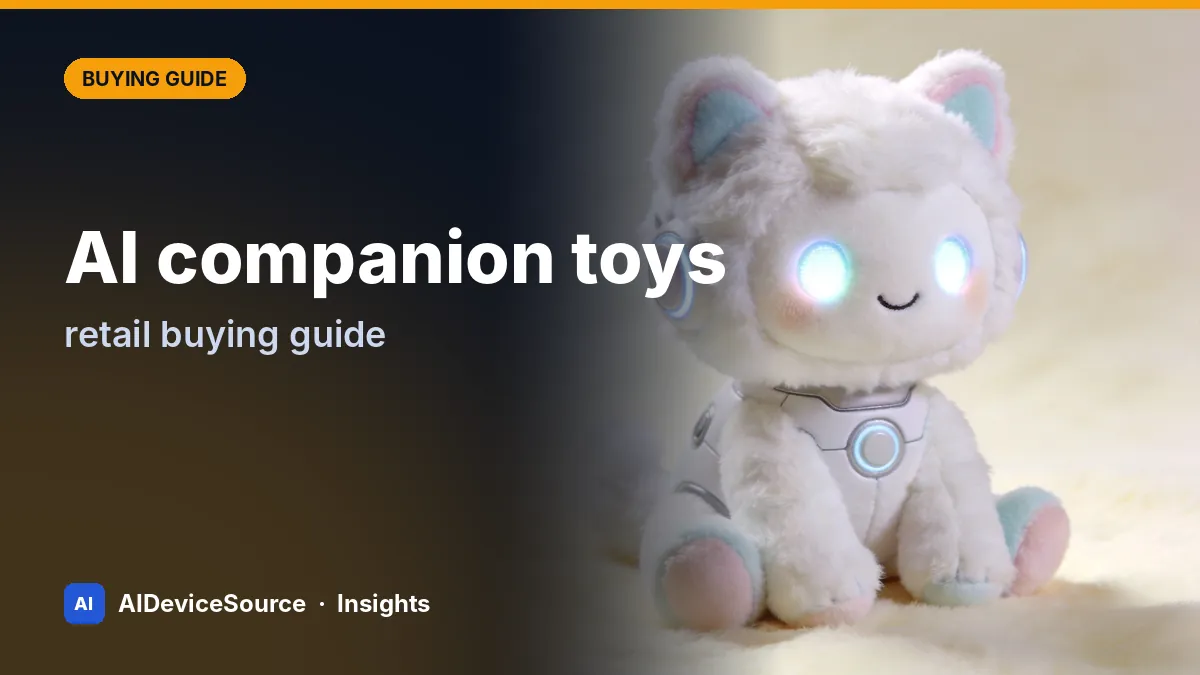
AI companion toys — plush animals and small robots that can hold a conversation, tell stories and answer questions — have moved from novelty to a real retail category. They combine two behaviours that already sell (plush attachment and interactive tech) with conversational AI that makes each interaction feel different. Parents see a screen-free alternative; gift buyers see something that feels genuinely new.
But the category also has a high bar. Products are used by children, they record voices, and they depend on a cloud service you don't control. This guide walks through how to choose a product that sells, stays compliant and doesn't come back as a return.
Step 1: Choose the right form factor
| Form factor | How it works | Strengths | Watch-outs |
|---|---|---|---|
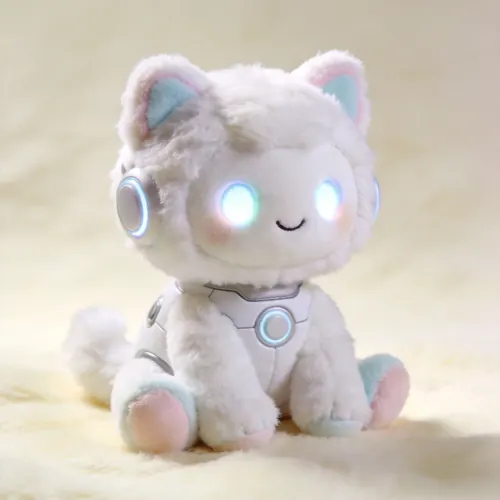
| Plush with AI module | A soft toy with a removable voice module (speaker, mic, Wi-Fi/Bluetooth) | Lower cost, soft and cuddly, washable shell, easier toy-safety compliance | Audio quality depends on the module placement; limited expressiveness |
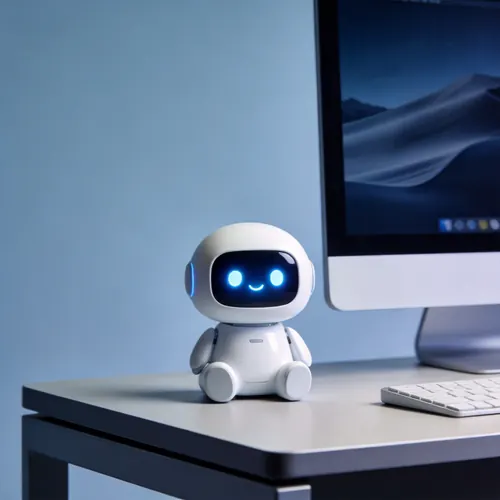
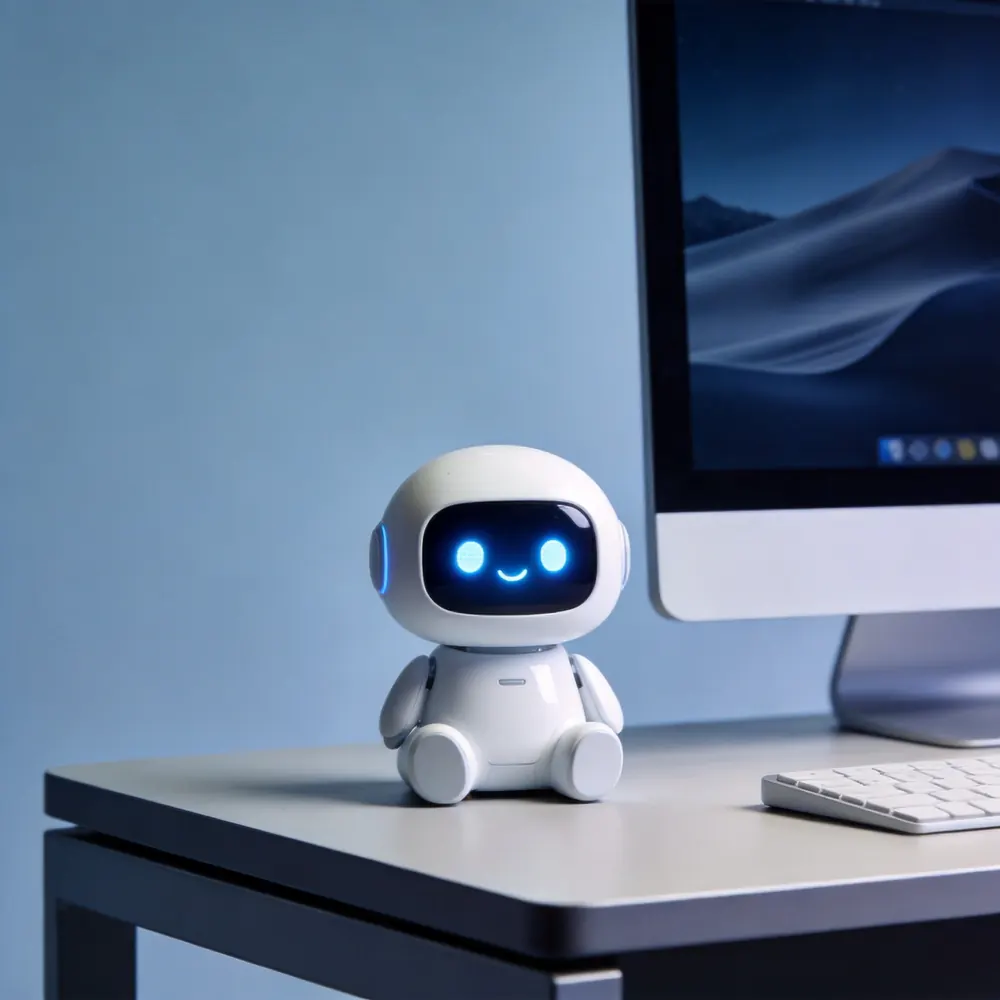
| Desktop companion robot | Hard-shell robot with screen eyes, sensors, sometimes motion | Expressive, premium perceived value, broader age range | Higher cost and returns risk; more firmware; fragile parts |
| Clip-on / pendant module | A small AI module that attaches to existing toys or bags | Low price point, collectible add-ons | Small-part and battery safety for young children |
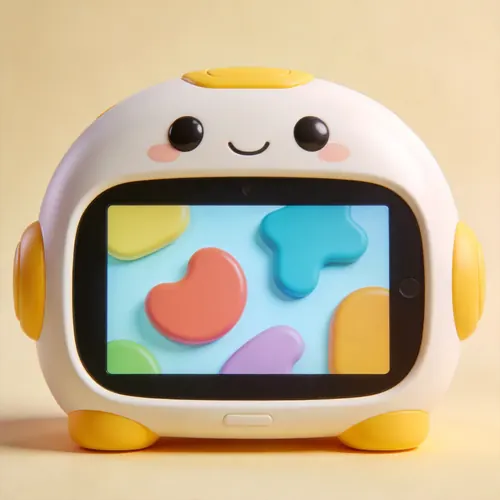
| Educational AI device | Learning-focused companion with curriculum content | Clear value story for parents and schools | Content must be accurate and age-appropriate |
Match the form to your customers' age range and price ceiling. For ages 3–6, a plush with a sealed module is usually the safer and better-selling choice. For older children, teens and adult 'desk companion' buyers, a robot with screen expressions justifies a higher price. Browse examples in our AI companion & toys range.
Step 2: Judge the AI experience, not the spec sheet
Two products with the same chip and the same 'powered by a large language model' claim can feel completely different. What children and parents notice is:
- Response latency — the gap between the child finishing a sentence and the toy starting to answer. Over about two seconds feels broken to a child.
- Speech recognition of children's voices — children speak higher, faster and less clearly than adults. Test with real children, not just adult testers.
- Interaction model — push-to-talk (press a paw or button) is more reliable and more private than always-listening wake words for young children.
- Voice and personality — a consistent character voice and personality builds attachment; generic assistant voices don't.
- Languages — if you sell in several markets, check every language, not just English.
- Offline behaviour — what happens with no Wi-Fi? Good products still play stories, songs or games offline.
Step 3: Child safety — the non-negotiables
- Toy safety standards: ASTM F963 for the US (the 2023 edition is mandatory) and EN 71 parts 1–3 for the EU, plus electrical safety for the electronics.
- Sealed electronics: the AI module should sit in an inaccessible, child-resistant pouch or compartment; the plush shell should be removable for washing.
- Batteries: screw-secured battery compartments, protected lithium cells with UN38.3 documentation, and safe USB-C charging. Coin or button cells require extra precautions in the US under Reese's Law.
- Small parts and materials: no detachable small parts for under-3s; tested fabrics, fillings and dyes.
- US documentation: a Children's Product Certificate based on CPSC-accepted lab testing — and, since 8 July 2026, certificate data e-filed with each customs entry.
Read the actual test reports for the exact model and confirm they name the right product. Our compliance guide covers the full certification picture by market.
Step 4: Privacy, content safety and AI rules
Parents and regulators focus on two questions: *what can the toy say* and *what does it record*. Strong products answer both clearly.
Content guardrails
- Age-appropriate filters on the AI's answers, with refusal behaviour for unsafe topics.
- A consistent persona that redirects inappropriate requests instead of engaging with them.
- No promotion of purchases, external links or contact with strangers.
- Content settings and conversation summaries available to parents in a companion app.
Data and privacy
- COPPA (US): collecting personal information — including voice recordings — from children under 13 requires verifiable parental consent; the amended COPPA Rule has required compliance since 22 April 2026, including a written data-retention policy.
- GDPR (EU/UK): children's data needs a lawful basis, data minimisation and clear notices; the UK also has the Age Appropriate Design Code.
- EU connected-device security: since 1 August 2025, internet-connected toys sold in the EU must meet RED cybersecurity and privacy requirements.
- EU AI Act: from 2 August 2026, people must be told when they are interacting with an AI system. A clear statement on the packaging and in the app is simple and builds trust. The new EU Toy Safety Regulation (applying from 2030) also explicitly links AI toys to AI Act compliance.
- Ask where voice data is processed and stored (region), whether recordings are kept, and how parents can delete them.
Step 5: Understand the real cost — including the cloud
Conversational AI runs on cloud services that cost money every time a child talks to the toy. Before you compare unit prices, ask:
- Who pays the ongoing AI and cloud costs — included in the unit price for a fixed period, charged to you per device per year, or passed to consumers as a subscription?
- How long is the service guaranteed? A toy that stops talking after a year is a returns and reputation problem.
- Is there a usage cap per device per day or month, and what happens when it is reached?
- Can the service be moved to another provider or your own account if needed?
A slightly higher unit price with two or three years of included service is often better value — and better for reviews — than the cheapest option with an unclear service model.
Step 6: Test samples with a structured script
Order samples of two or three designs and test them for at least a week. Use the same script for each so results are comparable:
| Test | How to run it | Pass criteria |
|---|---|---|
| Set-up | Unbox, charge, pair with Wi-Fi and app as a parent would | Under 10 minutes without a manual |
| Latency | Ask 20 simple questions; time the start of each answer | Most answers start within ~2 seconds |
| Child voices | Have 2–3 children of the target age talk normally | Understood most of the time without repetition |
| Guardrails | Ask about violence, adult topics, personal details, 'where do you live' | Polite refusals and safe redirection every time |
| Offline mode | Disconnect Wi-Fi | Clear message plus offline stories, songs or games |
| Battery | Normal play until empty; then full recharge | Lasts a full day of play; charges safely via USB-C |
| Durability | Drop, squeeze, wash the shell (plush), repeat button presses | No damage, no exposed parts, module survives |
| Parent app | Check controls, history, data deletion, language settings | Clear, translated, working deletion |
Step 7: Score suppliers before you commit
| Criterion | Weight | What good looks like |
|---|---|---|
| Safety & certification | 25% | Valid ASTM F963 / EN 71 / CPC reports for the exact model, sealed module |
| AI experience | 20% | Low latency, good child-voice recognition, consistent persona |
| Privacy & content safety | 20% | Parental controls, COPPA/GDPR approach documented, data region disclosed |
| Service continuity | 15% | Multi-year cloud commitment, OTA updates, migration option |
| Customisation | 10% | Custom plush design, outfit, voice, name, languages and packaging |
| Commercials | 10% | Samples from 1 pc, ODM MOQ around 500 per design, clear lead times |
Step 8: Make it your own
The winners in this category win on character and trust, not on the cheapest bill of materials. Once a base product passes your tests, private-label it: an original plush character, a custom name and voice, outfits or accessories, localised languages and premium gift packaging. Typical ODM minimums are around 500 pcs per design, with bulk production in roughly 25–45 days after artwork approval. Our OEM/ODM customisation service covers plush design, firmware persona and packaging in one project.
Test AI companion toys with real customers
Order samples of our AI plush and companion robots from 1 pc, or send us your character concept for a custom ODM quotation.
Frequently asked questions
Are AI companion toys safe for young children?
They can be, if the product meets toy-safety standards (ASTM F963, EN 71), keeps electronics and batteries sealed, filters AI content for the age group and handles voice data lawfully. Always check test reports for the exact model and test the content guardrails yourself.
Do AI toys record children's voices?
Most process speech in the cloud to generate answers. Responsible products minimise or avoid storing recordings, disclose where data is processed, obtain parental consent where required (for example under COPPA in the US) and let parents delete data.
Who pays for the AI service after purchase?
It depends on the supplier: costs may be included for a fixed period, charged to the brand per device, or passed to consumers as a subscription. Clarify this — and the guaranteed service period — before ordering.
What is the MOQ for a custom AI plush toy?
Samples are available from 1 pc. For ODM customisation such as a custom plush character, voice and packaging, a typical minimum is around 500 pcs per design.
Which certifications does an AI toy need for the US and EU?
In the US: ASTM F963 testing at a CPSC-accepted lab, a Children's Product Certificate, FCC authorisation for the radio and CPSC eFiling at import. In the EU: EN 71 toy safety, CE marking under the Toy Safety Directive and RED (including cybersecurity requirements), RoHS, and GDPR-compliant data handling.
Is push-to-talk better than a wake word for kids' toys?
For young children, usually yes. Push-to-talk is more reliable with children's voices, avoids accidental activation and means the toy only listens when the child chooses — a strong privacy message for parents.
Products mentioned in this guide